
The Ultimate Guide to the M’Goun Traverse in Summer
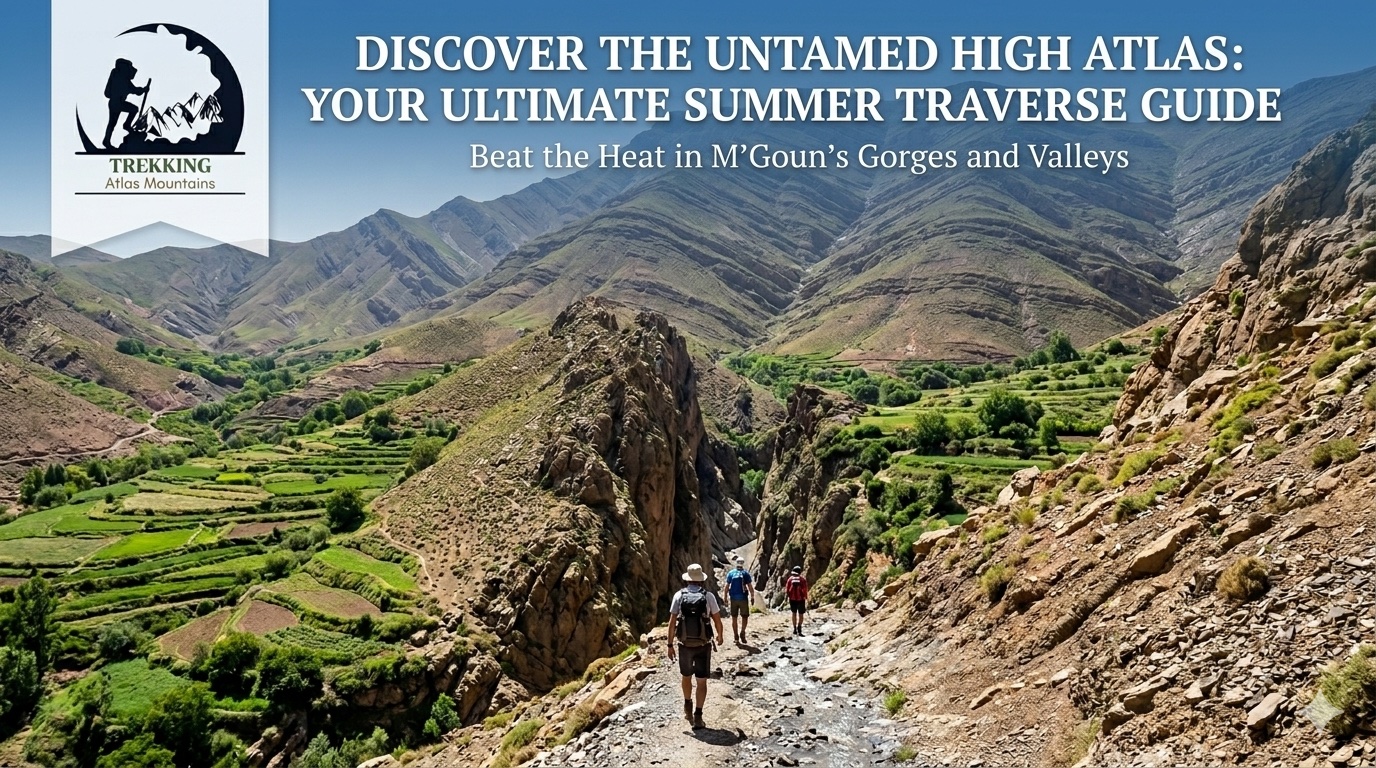
When summer hits Morocco, temperatures in Marrakech, Fes, and the Sahara Desert routinely skyrocket past 40°C. For outdoor enthusiasts, this heat makes exploring the lowlands exhausting, leading many to search for cooler, high-altitude alpine alternatives. Fortunately, the Central High Atlas holds North Africa’s best-kept secrets, and tackling the M’Goun Traverse in summer offers the ultimate escape into pristine landscapes, lush terraced green fields, and deep, refreshing river canyons.
Standing at an impressive 4,068 meters (13,346 feet), Mount M’Goun is Morocco’s second-tallest peak. Yet, while its famous neighbor Jebel Toubkal suffers from heavy tourist trail congestion, the M’Goun region receives a fraction of the foot traffic. Known locally as the “Happy Valley,” the starting point of Ait Bouguemez offers pristine, untouched landscapes, lush terraced green fields, and deep, refreshing river canyons.
At Trekking Atlas Mountains, we design custom summer expeditions through this remote wilderness. If you are looking to escape the summer heat, dive deep into authentic Amazigh (Berber) culture, and tackle a rewarding 4,000-meter peak, this ultimate guide to the M’Goun Traverse in summer is your roadmap.
Why June to September is the Prime Window for M’Goun
Unlike other global alpine ranges that close up or become highly dangerous during the summer, the Central High Atlas flourishes between June and September.
Perfect Mountain Weather: While the plains bake, temperatures on the high Tarkeddit Plateau and M’Goun ridges fluctuate between a pleasant 22°C to 26°C during the day.
Accessible Ridges: The heavy winter snowpacks completely melt by June, revealing incredible geological ridgelines and making the summit accessible without technical ice gear or crampons.
Active Nomadic Culture: Summer is the season of transhumance. You will share the vast highland plateaus with Ait Atta semi-nomads who migrate up from the desert fringes to graze their camels, sheep, and goats in the high pastures.
The Classic 6-Day M’Goun Traverse Itinerary
A successful, safety-first traverse requires proper acclimatization. Below is the proven route used by our certified guides at Trekking Atlas Mountains.
1.Marrakech to the Happy Valley (Ait Bouguemez):Day 1 • 5 hrs drive, 3 hrs trek.
Depart early from Marrakech via private transport, winding up past Azilal into the fertile Ait Bouguemez Valley. Meet your muleteers and mountain cook in Agouti (1,780m). Hike along the meandering Arous River through fields of poppies and walnut trees up to the sheepfolds of Ikkis n’Arous (2,200m) for your first night of wild camping.
2.Cross Tizi n’Tarkeddit to the High Plateau:Day 2 • 5-6 hrs trek.
A steady, progressive switchback climb takes you to the Tarkeddit Pass at 3,400 meters, where the massive, wave-like limestone crest of Jebel M’Goun comes into view. Descend onto the vast, wind-swept Tarkeddit Plateau (2,900m). Set up camp near the mountain refuge, surrounded by nomadic grazing camps.
3.The Summit Ridge to Oulilimt Sources:Day 3 • 8-9 hrs trek.
An alpine start at 4:30 AM. Climb steadily behind your guide under a star-filled sky to reach the dramatic, knife-edge summit ridge. Walk along the top of the world at 4,068 meters for breathtaking 360-degree views stretching toward the Saharan plains. Descend through long scree slopes to camp by the natural springs of Assif n’Oulilimt (2,640m).
4.Gorge Exploration to Aflafal:Day 4 • 4 hrs trek.
A shorter, highly rewarding recovery day. Trek through the winding rock towers and unique erosion chimneys of the upper M’Goun gorge. Camp at Aflafal (2,270m) right by the riverside, where you can refresh your feet in the cool mountain waters and meet local shepherds.
5.Return via Tizi n’Ait Imi to Tabant:Day 5 • 6 hrs trek.
Follow the historical transhumance paths to the Tizi n’Ait Imi pass (2,905m). This pass acts as a stunning panoramic boundary looking back into the rugged M’Goun valleys and forward into the green paradise of Ait Bouguemez. Drop back down to the village of Ait Imi and celebrate with a hot shower and traditional dinner at a local Berber guesthouse.
6.Ouzoud Waterfalls to Marrakech:Day 6 • 5 hrs drive.
After a fresh village breakfast, load into the private vehicle. On the drive back to Marrakech, enjoy a celebratory lunch stop at the dramatic Ouzoud Waterfalls—the highest falls in North Africa—before returning to the city by evening.
Essential Gear and Practical Logistics
Trekking in the Central High Atlas requires careful preparation for both intense sun exposure and sudden alpine changes.
1. Summer Footwear Strategy
Because parts of the valley descent involve walking directly through shallow riverbeds and narrow gorges, packing the right footwear is non-negotiable. You need:
Sturdy, broken-in trekking boots with deep lug soles for the rocky mountain scree.
A dedicated pair of water-hiking shoes, trail sandals, or light sneakers specifically for wading through the water channels.
2. High-Altitude Sun Protection
The UV index on the Tarkeddit Plateau routinely reaches extreme levels (11+). Ensure your daypack contains a wide-brimmed hat, UV-blocking sunglasses, and high-factor sunscreen. Cover up with light, breathable, long-sleeve merino wool or synthetic layers.
3. Hydration & Pack Logistics
You will need to consume at least 3 to 4 liters of water daily. Bring reusable, heavy-duty water bottles or hydration bladders along with water purification tablets (such as Aquatabs) or a filtration pump.
How it works with Trekking Atlas Mountains: You only carry a light daypack containing your water, jacket, and camera. Our team of local muleteers and camp crews handles all the heavy lifting, transporting your main duffel bags, cooking gear, and state-of-the-art camping tents between sites.
Direct From the Trail: Frequently Asked Questions
Is climbing Mount M’Goun safe in the summer?
Yes, summer is the safest time to tackle the M’Goun traverse because the risks of snowstorms, freezing ice sheets, and blocked mountain passes are virtually zero. However, afternoon summer thunderstorms can occasionally occur in the High Atlas. Our certified mountain guides monitor local weather patterns closely and adjust trail schedules to ensure teams are off the high ridges before any storms roll in.
How difficult is the M’Goun ascent compared to Jebel Toubkal?
While Jebel M’Goun is technically non-climbing (a walking trek over rock and scree), it is physically more demanding than Toubkal. The summit day involves a long, sustained push across an exposed 4,000-meter ridge line that takes roughly 8 to 9 hours of total walking. It is best suited for trekkers with good cardiovascular fitness and a spirit of adventure. If someone in your party does not wish to summit, Trekking Atlas Mountains offers an alternative, gentle mule-track bypass directly to the evening camp.
Do I need a permit or a mandatory guide for the M’Goun trek?
While the strict checkpoint regulations found at Mount Toubkal are not yet fully implemented in the Central Atlas, hiring an official, certified guide is highly recommended for safety, navigation, and cultural connection. The trails are completely unmarked, water sources are hidden, and emergency communication is limited. Booking through a registered local agency like Trekking Atlas Mountains ensures you are accompanied by a licensed professional who speaks the local Tamazight language and understands the terrain flawlessly.
What is the accommodation like during the traverse?
During the wilderness phases of the trek (Days 1 through 4), accommodation consists of comfortable, heavy-duty camping tents pitched under the stars on beautiful alpine plateaus. We provide thick foam sleeping mattresses, a communal mess tent for dining, and a dedicated kitchen setup. At the beginning and end of the valley loop, you will stay in traditional, family-run Berber guesthouses (gîtes), offering a deep look into local hospitality, hot showers, and homemade Moroccan tajines.
Book Your Summer Wilderness Escape
Don’t spend your Moroccan summer stuck in the heat of crowded tourist traps. Experience the wild, majestic, and culturally rich side of North Africa.
Contact our expert planning team at Trekking Atlas Mountains today to secure your certified guide, mule crew, and custom summer itinerary for the ultimate M’Goun Traverse.
👉 Read our Google Reviews and discover why travelers trust Trekking Atlas Mountains for their Morocco trekking adventure.
 Previous Post
 Next Post